EnviroQuest

Photography by Larry A Lyons

Yellowstone – The Landscape

An upcoming series of posts will be providing a “glimpse” of the National Parks in the United States including Yellowstone, Grand Tetons, Badlands, Redwood Forests, Yosemite, Death Valley, Grand Canyon and others. This series is intended to provide a glimpse into the uniqueness of each national park encompassing the beauty of its topography, its geological make-up, and the distinct ecosystems supporting a diversity of wildlife and plant species.

This National Park series will begin with Yellowstone National Park, which is the first U.S. National Park established in 1872.

Yellowstone is situated in the northwest corner of Wyoming and includes small areas of Montana and Idaho. It encompasses 2.2 million acres (or 3,400 square miles). It is an area larger than the states of Delaware and Rhode Island combined.
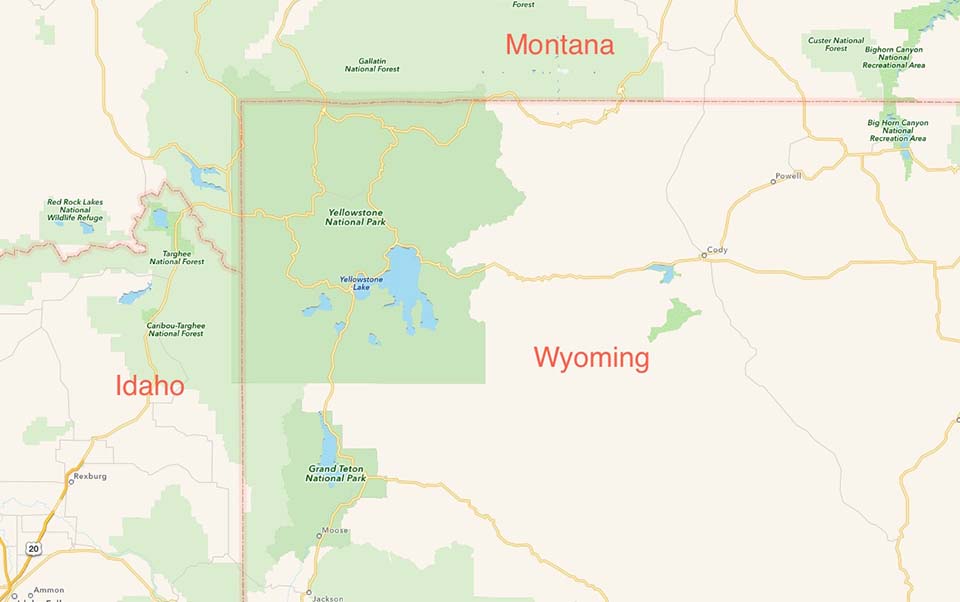
'May of Yellowstone'

‘Map of Yellowstone’

Yellowstone is one giant volcano resting on top of one of the largest magna chambers in the world. The last major eruption was 600,000 years ago. From 1,000 to 3,000 earthquakes occur each year at Yellowstone, but most are too small to be felt.

Geysers and Steam Vents Galore' © Larry A Lyons

Geysers and Steam Vents Galore’ © Larry A Lyons

Yellowstone is home to more than 10,000 geothermal features encompassing geysers, hot springs, steam vents and baths, and percolating mud baths. All of these geothermal features are fueled by heat just a few miles underground.

Sixty percent of the world’s geysers are situated in Yellowstone with over 200 active geysers. Geysers are hot springs that are constricted at the surface that periodically erupt into a fountain of boiling water and steam.

The ‘Old Faithful’ geyser is probably the most famous geyser in the world, not because it is the tallest geyser, but rather it is one of the more predictable geysers. ‘Old Faithful’ erupts several times each day and its eruption is predictable within 30 minutes prior to erupting. Eruptions may occur as frequently as every 60 to 90 minutes. Each eruption blasts 3,400 to 8,400 gallons (14,000 liters to 32,000 liters) of boiling water to a height of 120 feet (36 meters).

'Old Faithful' © Larry A Lyons

‘Old Faithful’ © Larry A Lyons

The reason “Old Faithful” is quite the predictable geyser is because it does not share its underground plumbing system with other geysers. Most of the water from geysers first arrives from rain or snow melt. The water seeps deep into the earth and begins a long recycling journey back up again. The journey can take 500 years or more before it is recycled and blasts into an eruption. In other words, the hot water erupting that this image captured was last seen during the time of Columbus.
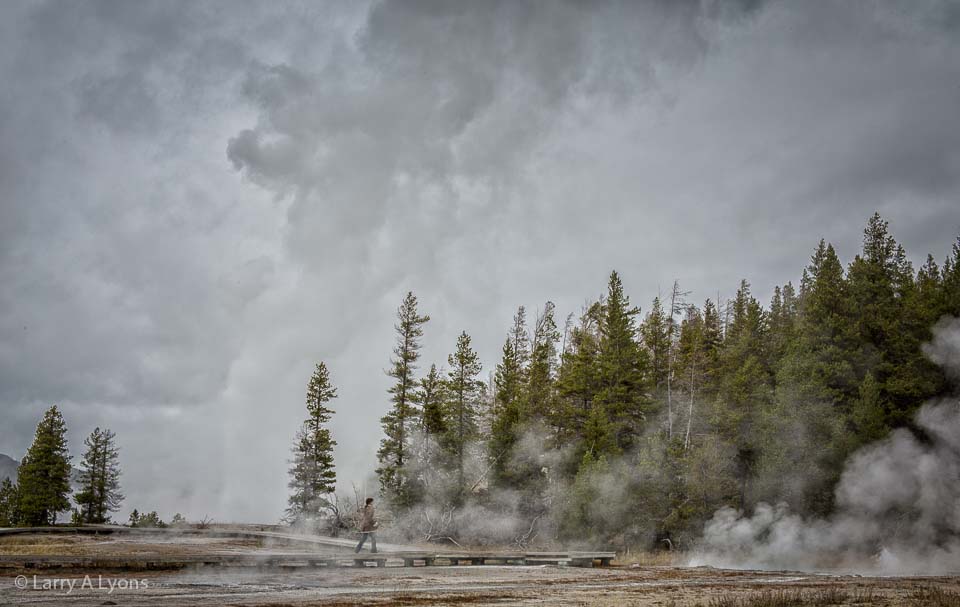
'Grand Geyser Erupting' © Larry A Lyons

‘Grand Geyser Erupting’ © Larry A Lyons

Grand geyser is consistently the tallest and perhaps the most spectacular of the predictable geysers. Grand geyser will erupt around every 8 to 12 hours and will blast to a height of 150 to 180 feet (46 to 55 meters).

'Petrified Trees' © Larry A Lyons

‘Petrified Trees’ © Larry A Lyons

Petrified trees border the Grand geyser pool area. There are two types of geysers, that is, either cone-shaped like the Old Faithful geyser or fountain-type geyser. The “Grand” geyser erupts from a pool of water to produce a fountain-type geyser. After the eruption has ended, the water will be out of sight or sometimes a pool of water will be visible.
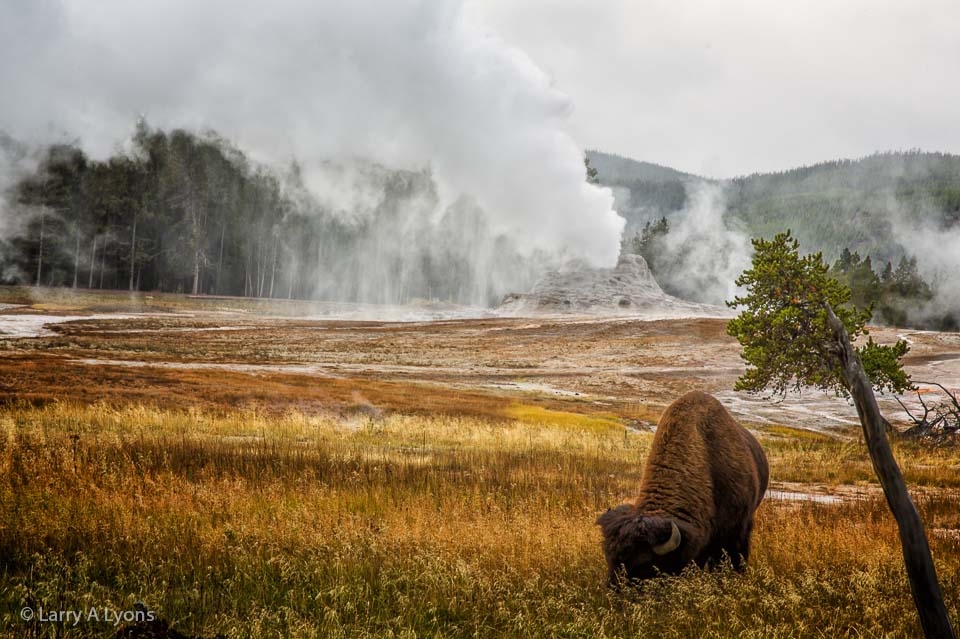
'Castle Rock Venting Steam' © Larry A Lyons

‘Castle Rock Venting Steam’ © Larry A Lyons

Castle geyser is considered a very old geyser that is 5,000 to 15,000 years that has a 12-foot (4-meter) cone. Castle geyser erupts at an interval between 9 to 11 hours. Bison are often seen grazing near the geysers.

'Hot Spring' © Larry A Lyons

‘Hot Spring’ © Larry A Lyons

Hot springs are the most common geothermal feature in which rising hot water is released as a runoff or as steam. Water temperatures can exceed 190 degrees F (90 degrees C). Unlike geysers with a pressurized plumbing system that erupts through a small constriction, hot springs have wide openings where super heated water is continuously circulating to the surface.
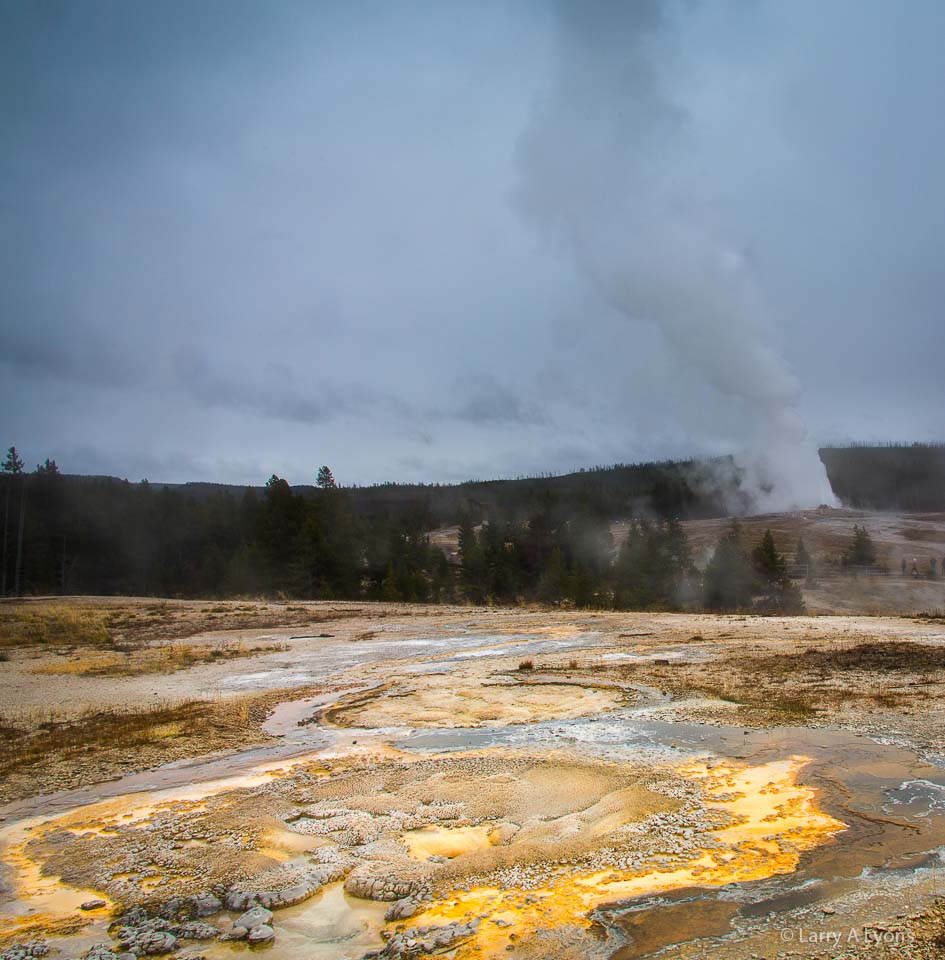
'Colorful Microbial Mats' © Larry A Lyons

‘Colorful Microbial Mats’ © Larry A Lyons

Colorful microbial mats, composed of trillions of pigmented bacteria, live in and around the hot springs. The colors can range across a wide spectrum of colors.

'Thermophiles' © Larry A Lyons

‘Thermophiles’ © Larry A Lyons

The bright colors found in Yellowstone’s hydrothermal basins originate from thermophiles – microorganisms that thrive in hot temperatures and the mineral-rich water.

'Close-up of Pigmented Microbial Mats' © Larry A Lyons

‘Close-up of Pigmented Microbial Mats’ © Larry A Lyons

'Small Geysers Sprouting' © Larry A Lyons

‘Small Geysers Sprouting’ © Larry A Lyons

Large Hydrothermal basins, like the ‘Grand Prismatic Spring’, also reveals extensive microbial mats with the vivid colors that flourish throughout the basin.

'Grand Prismatic Spring' © Larry A Lyons

‘Grand Prismatic Spring’ © Larry A Lyons

'Sunset Over Grand Prismatic Spring' © Larry A Lyons

‘Sunset Over Grand Prismatic Spring’ © Larry A Lyons

In addition to all of the geothermal features that Yellowstone has to offer, there are many other spectacular vistas including snow covered mountains and a golden grand canyon.

'Rocky Mountain Vista' © Larry A Lyons

‘Rocky Mountain Vista’ © Larry A Lyons

Here a couple of bison are resting in the grassy plateau while waterfowl wade in the pond. Yellowstone is home to 50 species of mammals and 300 species of birds. An upcoming post will provide a glimpse into the wildlife of Yellowstone.

The “Grand Canyon of Yellowstone’ is situated in the middle of the park with Yellowstone River flowing through it. The canyon is 24 miles (38 km) long and 1,200 feet (365 meters) deep. Yellowstone River drops an astonishing 300 feet (91 meters) at the Lower Yellowstone Falls.

'Grand Canyon of Yellowstone' © Larry A Lyons

‘Grand Canyon of Yellowstone’ © Larry A Lyons

This golden canyon was formed from volcanic rock about 600,000 years ago. The golden color of the volcanic rock evolved from the iron in the rock that had become ozidized from steam and hot water.

'Volcanic Rock Close-up' © Larry A Lyons

‘Volcanic Rock Close-up’ © Larry A Lyons

Yellowstone River is recognized as the longest free-flowing (undammed) river in the United States.

'Upper Yellowstone Falls' © Larry A Lyons

‘Upper Yellowstone Falls’ © Larry A Lyons

Forest fires are an important part of Yellowstone’s ecosystem and has become to be understood that fires are a natural regeneration process. Yellowstone, like other parks, have instituted a natural fire management plan that allows fires caused by lightning to burn out on their own. For instance in 2013 there were 15 fires. Of the 15, eleven of the fires were only 0.1 to 1.0 acres in size. The remaining four fires ranged in size from 189 acres to 7,200 acres for a total of 11, 933 acres. Five of the 2013 fires were attributed to human activity while the remaining ten fires were caused by lighting. In 2014, there were only five fires reported and each of those fires was only 0.1 acres in size.

'Forest Regeneration' © Larry A Lyons

‘Forest Regeneration’ © Larry A Lyons

Many of Yellowstone’s plant species are fire-adapted. For instance, lodgepole pines (Pinus contorta), which make up nearly 80% of the park’s extensive forests, have cones that are sealed by resin until the intense heat of fire cracks open and releases the seeds inside.
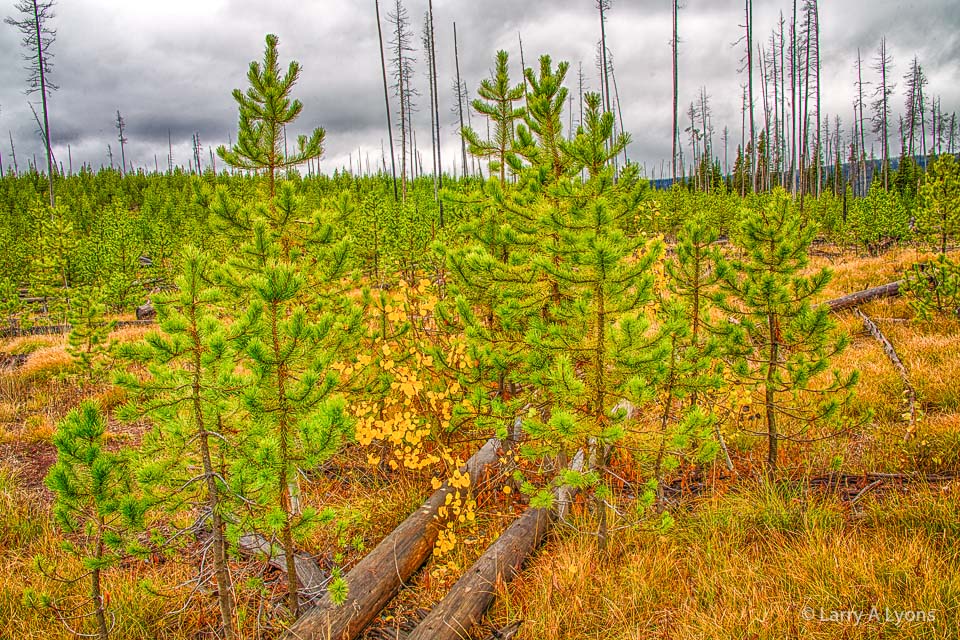
Pine and Aspen Saplings' © Larry A Lyons

Pine and Aspen Saplings’ © Larry A Lyons

One lonely Aspen sapling along with the pine saplings are in the process of regenerating into a new forest. Fires may stimulate regeneration of aspen, sagebrush, and willows, but the interactions between these plants and fire is complicated by other influences such as grazing levels and climate.

The scenery of Yellowstone at night can be as grand as the daytime hours.

'Night Eruption of Old Faithful' © Larry A Lyons

‘Night Eruption of Old Faithful’ © Larry A Lyons
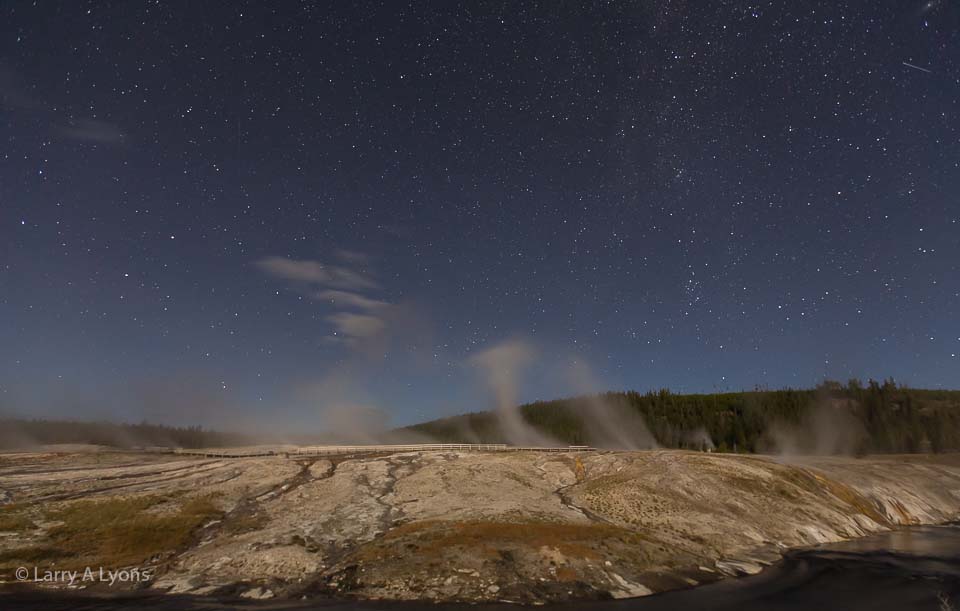
'Venting To The Stars' © Larry A Lyons

‘Venting To The Stars’ © Larry A Lyons

'Big Dipper and Yellowstone' © Larry A Lyons

‘Big Dipper and Yellowstone’ © Larry A Lyons

Here a full moon is shining through Old Faithful’s eruption.
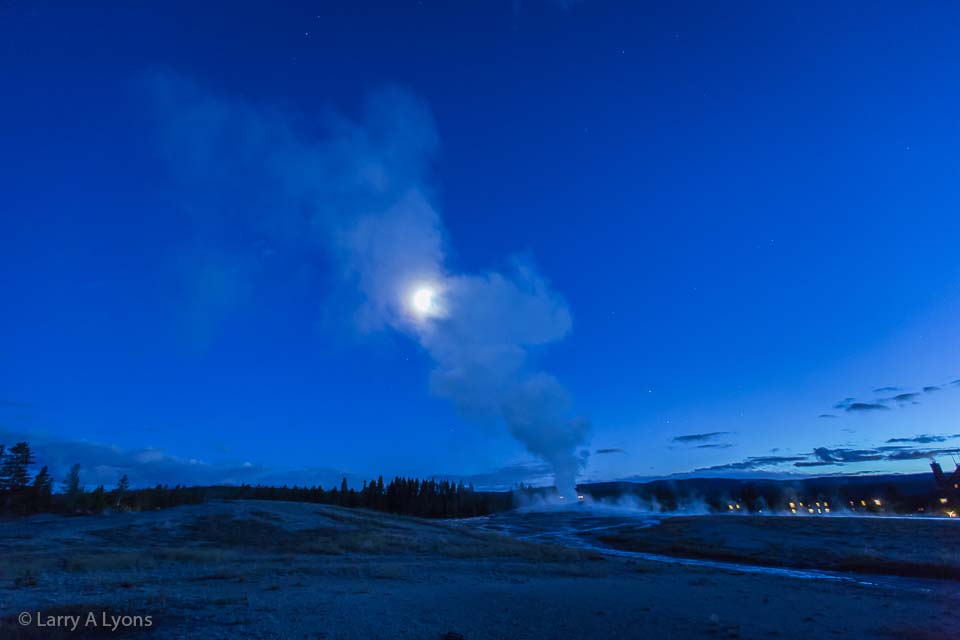
'Goodnight Yellowstone' © Larry A Lyons

‘Goodnight Yellowstone’ © Larry A Lyons

Bid adieu to Yellowstone for now. What a magnificent treasure! Stay tuned for upcoming posts. Two more posts on Yellowstone will be forthcoming. One is a glimpse of Mammoth Springs, which consists of extensive limestone formations generated by the hot springs of Yellowstone, and the wildlife of Yellowstone. In addition, a ‘glimpse’ into other National Parks, including Grand Tetons, Badlands, Redwood Forests, Yosemite, Death Valley, and Grand Canyon, will be forthcoming.

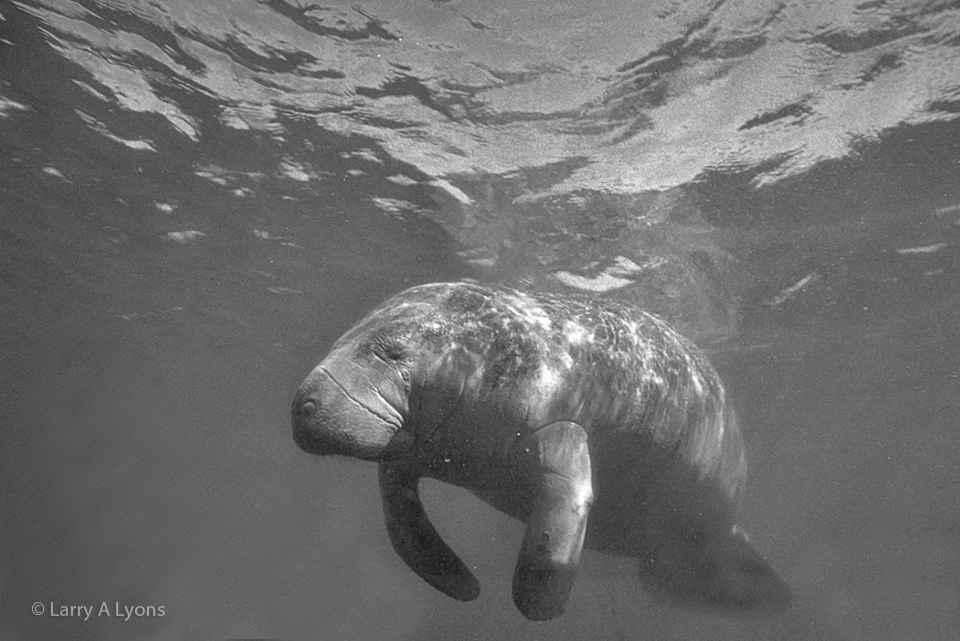


Endangered Manatee – A Gentle Giant

To read more about the images of this gallery go to:

Endangered Manatee – A Gentle Giant

Endangered Manatee – A Gentle Giant

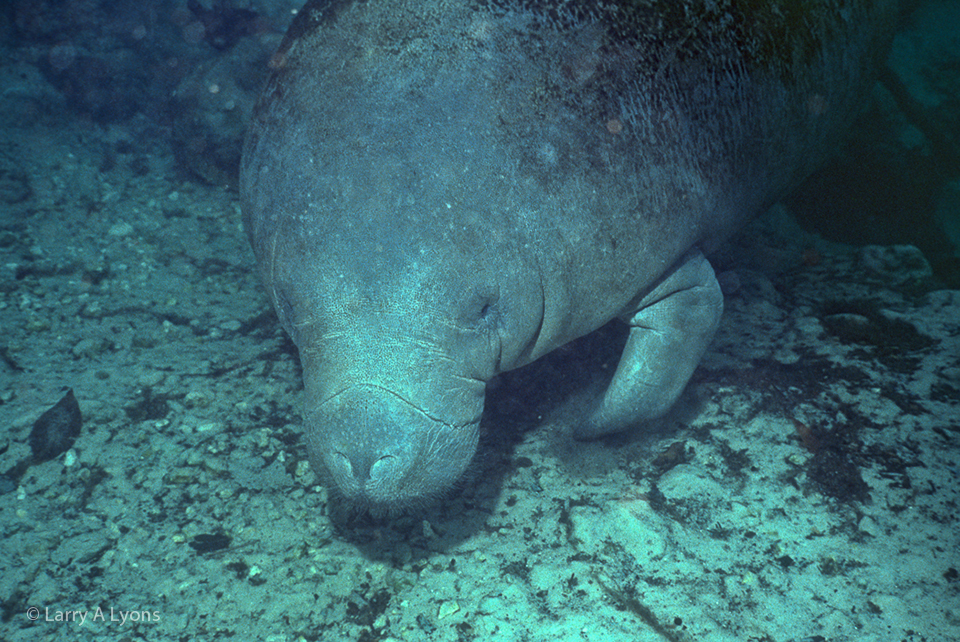
The manatee is an endangered species living in coastal estuaries and freshwaters in Florida. It is currently estimated that the “minimum” current population stands at about 5,000 manatees within the state of Florida.

'Endangered Manatee' © Larry A Lyons

‘Endangered Manatee’ © Larry A Lyons

The endangered manatee is a large mammal also known as a sea cow. Manatees are believed to evolve from plant-eating and wading-like mammals with their closest relative being the elephant. In spite of their cuddly-like appearance and non-aggressive manner, manatees are as wild as free-ranging elephants.

'The Graceful Manatee' © Larry A Lyons

‘The Graceful Manatee’ © Larry A Lyons

Manatees are migratory animals and in the summer will migrate along the eastern and western coasts of Florida. Some individuals will migrate as far north as the Carolinas and as far west as Texas. However, during the winter calendar months manatees do tend to concentrate near warm water springs or near thermal discharges of power plants within Florida. When water temperatures go below 68 degrees Fahrenheit (20 degrees Centigrade), the stress from the colder waters can be fatal. In the winter of 2010, more than 280 manatees died from an extended period of cold weather.

One of the longest-term threats to the manatees is the loss of habitat of warm water habitats. Residential development in Florida continues to encroach on these warm water spring habitats that are essential for their survival. Although power plant discharges do provide the essential warm water for a large portion of the manatee populations, the expectations of these power plants not shutting down because of equipment failure or even being decommissioned creates a high risk to the manatee populations. A means of conserving “natural” warm water habitats within Florida is absolutely critical.

'The Sea Cow' © Larry A Lyons

‘The Sea Cow’ © Larry A Lyons

The Crystal River National Wildlife Refuge including the Kings Bay in Florida, which is also referred to as the manatee capital of the world, was established for the protection of the endangered manatees in 1983. The warm water springs originating from Crystal River provide a critical sanctuary for the manatee populations that migrate there each year from November to April. During the winter months it is estimated that up to 600 manatees migrate into this sanctuary.

All of these images were captured at the Crystal River sanctuary using a Nikonas V underwater film camera in January 1995. The Crystal River sanctuary has become a tourist attraction where it is estimated that 150,000 visitors come each year. Visitors are permitted to snorkel with the endangered manatees within designated areas following specific guidelines. Unfortunately there have been disturbing instances in which people have been harassing the manatees and swimming in areas that are strictly for manatees only. Of particular importance is that all watercraft travelling through manatee sanctuaries do so cautiously and at idle speed.

It really is a remarkable and unforgettable experience to be able to swim with these gentle giants. If you have the opportunity, be sure to abide to the specific guidelines defined by U.S. Fish and Wildlife Service.

'Vulnerable Swimmer' © Larry A Lyons

‘Vulnerable Swimmer’ © Larry A Lyons

Manatees are graceful swimmers powered by a strong tail. They generally swim along at three to five miles (5 to 8 kilometers) an hour, but they can swim up to 15 miles (24 kilometers) an hour on short bursts. Manatees are generally observed swimming close to the surface that creates a high level of risk of being injured or killed from outboard motors.

Manatee mortalities are recorded each year by the Florida Fish and Wildlife Conservation Commission. These mortality counts define whether mortalities are the result of watercraft accidents, cold stress, natural causes, perinatal causes, undetermined causes, and other causes. From 2007 through 2013 it is estimated on the average that at least 20 percent of the manatee mortalities resulted from being struck by watercraft. It is also important to note that this 20 percent mortality from watercraft does not include all of the mortalities that were undetermined or the mortalities that go unreported.

'Manatee Close-up' © Larry A Lyons

‘Manatee Close-up’ © Larry A Lyons

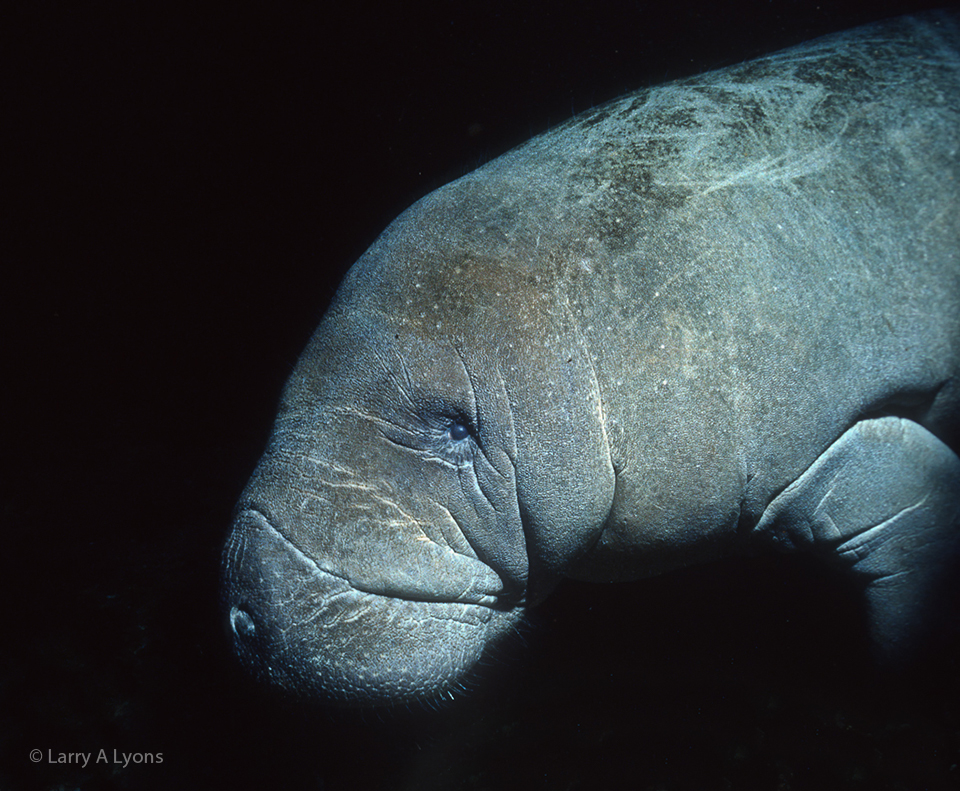
The manatee with their small eyes and no outer ears do have good sight and hearing. Manatees emit a variety of sounds used in communication. They can also communicate by smell, taste and touch. Their face contains over 600 vibrissae (whisker-like hairs), but the sensory function of the whiskers is unknown.

'Taking A Breath' © Larry A Lyons

‘Taking A Breath’ © Larry A Lyons

Manatees must resurface regularly to breathe air through their nostrils. When just resting, manatees may resurface every 20 minutes. However, when they are moving about and consuming energy, they may resurface for a breath every three to five minutes. Resurfacing to breathe or just resting in shallow waters creates a high level of vulnerability for their survival from being accidently hit by boats. In fact, researchers can often identify many surviving manatees by the scars that have resulted from being injured from outboard motors.

'Herbivorous Mammal' © Larry A Lyons

‘Herbivorous Mammal’ © Larry A Lyons

Manatees are herbivores grazing on algae, sea grass and a variety of other aquatic plants. They consume 10 to 15% of their body weight in vegetation each day. By far, sea grass beds would be the most important source of vegetation for the manatees. The manatee above is grazing on algae and stirring–up sediment in the process.

'Gentle Giant' © Larry A Lyons

‘Gentle Giant’ © Larry A Lyons

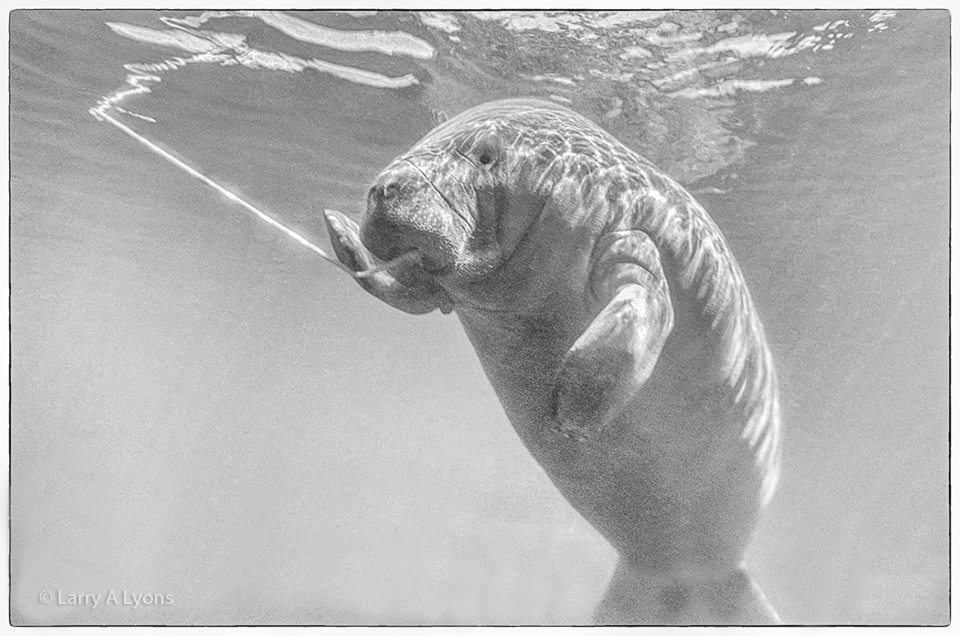
Manatees are gentle giants with an average length of ten feet (3 meters) and weighing up to 1,200 lbs. (540 kg). This manatee was attempting to remove any algae on this rope that was dangling in the water.

Red tides are another major threat to the manatees. Red tides are algal blooms of a specific algae that contain neurotoxins. Red tides are naturally occurring events that will occur offshore. If the blooms move inshore, an extended algal bloom can occur from nutrient loading by urban and agricultural runoff. Manatees are exposed to the neurotoxins when they come to the surface to breathe and when grazing on grasses coated with the algae. The neurotoxins cause seizures and subsequent drowning of manatees. In 2013 it was estimated that as a many as 276 mortalities may have resulted from red tidal events. It is also important to note that the total mortality count for 2013 was 829 manatees, which is more than twice the mortalities reported in 2012.

'Pair Resting' © Larry A Lyons

‘Pair Resting’ © Larry A Lyons

Female manatee is usually larger than the male and breeds only once every few years. It is believed that only one calf is born every two to five years. The gestation period is 12 months. The calf is dependent on its mother for a 12 to 18 month period. This low reproduction cycle creates a high level of risk for their long-term survival.

News Flash: A July 2nd, 2014 news flash from the U.S. Fish and Wildlife Service (USFWS) stated that the agency is in the process of considering removing the manatee from the endangered species list to merely a species that is threatened. The USFWS is responding to a lawsuit originating from a citizens group, Save Crystal River, Inc. This citizens group is concerned about new idle-speed rules for watercraft and the expansion of manatee refuge areas in Kings Bay. It will be interesting to see how the USFWS decides on protecting the manatees.

'Protect The Manatee' © Larry A Lyons

‘Protect The Manatee’ © Larry A Lyons

So let’s recap on the vulnerability of manatee populations in Florida and why this gentle giant should remain as an endangered species for maximum protection. Manatees require warm water sanctuaries like the Crystal River for appropriate habitat during the winter months for their survival. Manatee dependence of thermal discharges from power plants for warm water habitat should be cautiously monitored. Conservation efforts to enhance and manage ‘natural’ warm water sanctuaries in Florida are critical.

Manatees have a low reproduction cycle with only one calf being born every two to five years. Manatees living, grazing and moving about in shallow waters causes a high level of risk from being killed or injured from the ever-increasing boat traffic in Floridian waters.

In addition to the high vulnerability from watercraft, manatees are vulnerable to the loss of turtle grass habitat, which is their main food staple. The population is quite vulnerable to any extended cold winters. In addition, the sudden appearance of red tides can decimate a large portion of the manatee population. The possibility of even sustaining the current manatee population should be one of grave concern.


References:

Save The Manatee Club

Defenders of Wildlife

Florida Fish and Wildlife Conservation Commission

U.S. Fish and Wildlife Service

African Exhibit Invitation

You are invited to our next “African Adventure” exhibit by Larry Lyons and Patricia Worley. The exhibit will be held at the Deptford Galleria, Deptford, NJ from June 9th until September 10th, 2014.   A reception and slide show will be provided on June 22nd from 2:00 to 4:00 p.m. The slide show will provide a conservation perspective of the most dangerous animals including the lion, leopard, buffalo, elephant and the rhino.

'An African Adventure Exhibit'

‘An African Adventure Exhibit’

This is the fifth exhibit that Larry and Pat have given related to their African experience.  The exhibit displays over 70 framed prints including the wildlife and the people of Africa. You do not want to miss this exhibit and reception.


An African Adventure: The People

You are invited to an exhibit entitled “An African Adventure: The People” by Larry Lyons and Patricia Worley. The exhibit will be at the Cherry Hill Library, Cherry Hill, NJ for the month of February 2014.

Here is the announcement about the reception:

'An African Adventure: The People'

‘An African Adventure: The People’

A reception and slide show will be provided on February 8th, 2014. The slide show will present the experiences that Larry and Pat had as volunteers with the African Impact Organization for a six-week period from from September through October 2012. The slide show presentation will focus on working and playing with the Zulu children, photographing people at work and even photographing  a wedding at a small village in Mozambique.

This is the third exhibit that Larry and Pat have given related to their African experience. The previous exhibits focused on the wildlife and conservation. Some of the images from the previous exhibits can be found at this blog.

Here are just a few selected images that are displayed at the exhibit:

The children are patiently waiting for their cue to pick-up their bowls and have their lunch. The children are provided a breakfast and lunch each day at school. Every morsel of food in their bowls is consumed.  The orderly behavior exhibited by the children was endearing that provided a display of innocence.

'Innocence' © Larry A Lyons

‘Innocence’ © Larry A Lyons

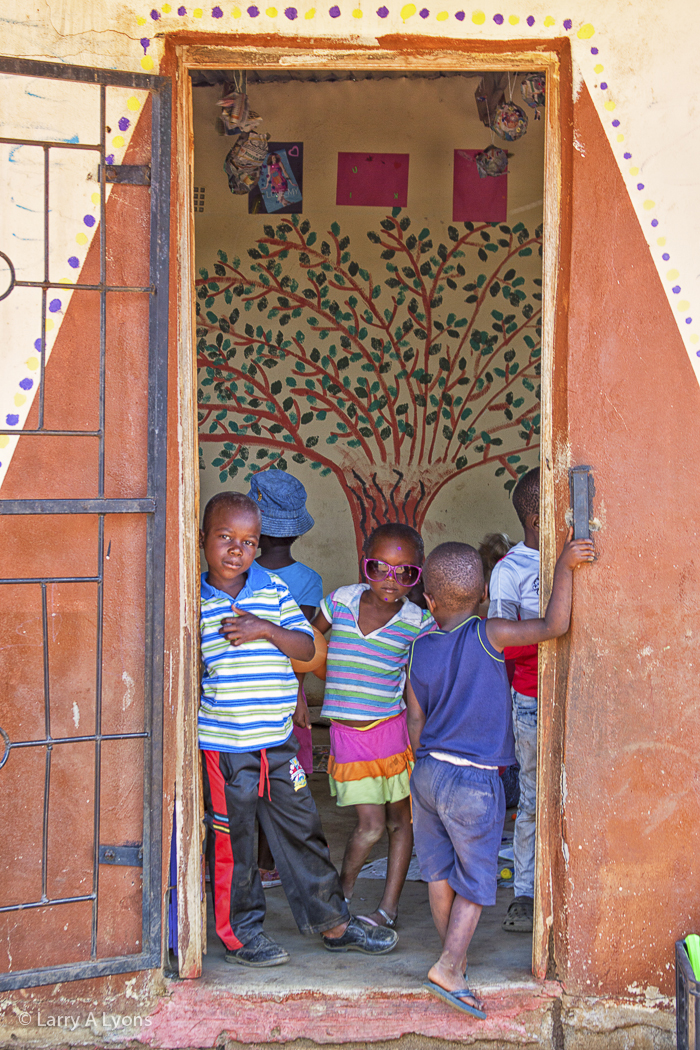
This is the door to the one-room schoolhouse (referred to as a creche) where these little ones were posing.  You can see some of the crafts that they created hanging from the ceiling. A creche provides the initial foundation of learning for these young Zulus.
'Tree of Knowledge' © Larry A Lyons

‘Tree of Knowledge’ © Larry A Lyons

Washing their hands before eating was a required ritual. This little one needed some help and her eyes just say “My Turn”.

'My Turn' © Larry A Lyons

‘My Turn’ © Larry A Lyons

Here the children are practicing their letters on an outdoor chalkboard.

'Learning The Alphabet' © Larry A Lyons

‘Learning The Alphabet’ © Larry A Lyons

Ziggy, a community relationship counselor for the African Impact Organization, is requiring each child to pronounce the letter and word before being permitted to go out and play. The children line-up and wait their turn. One child was held back until the end to try again.

'Rite of Passage' © Larry A Lyons

‘Rite of Passage’ © Larry A Lyons

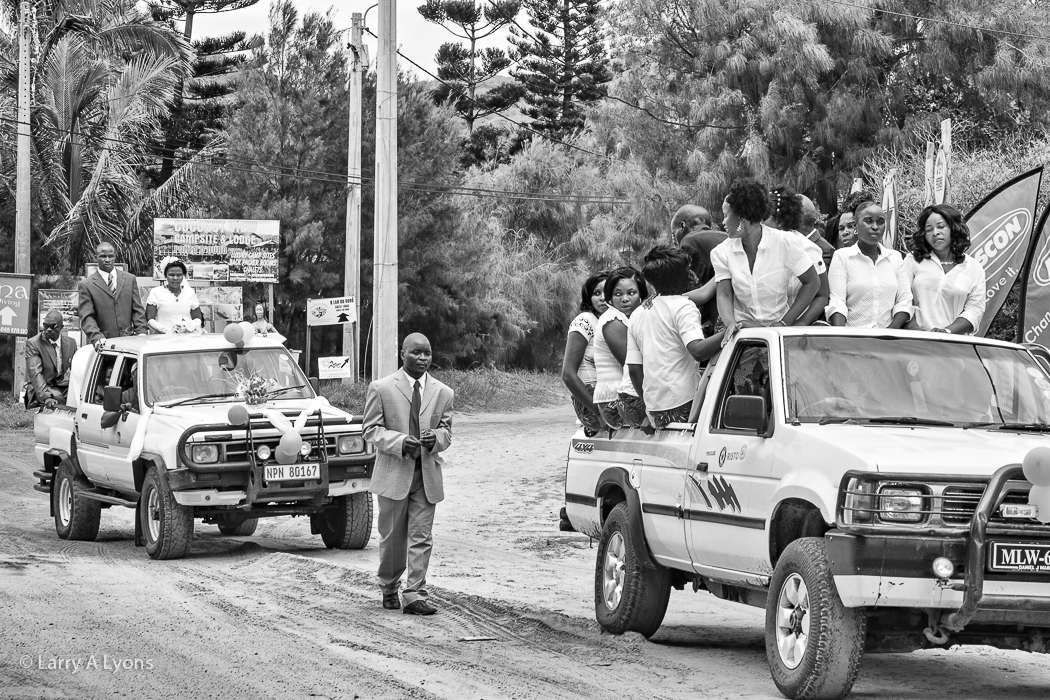
An unexpected encounter while strolling along the dirt roads of a seaside village in Mozambique was viewing and photographing a caravan of a wedding party. The first pick-up truck carried the entire troupe of bridesmaids while the bride and groom followed in a truck decorated with balloons.

'Wedding Caravan' © Larry A Lyons

‘Wedding Caravan’ © Larry A Lyons

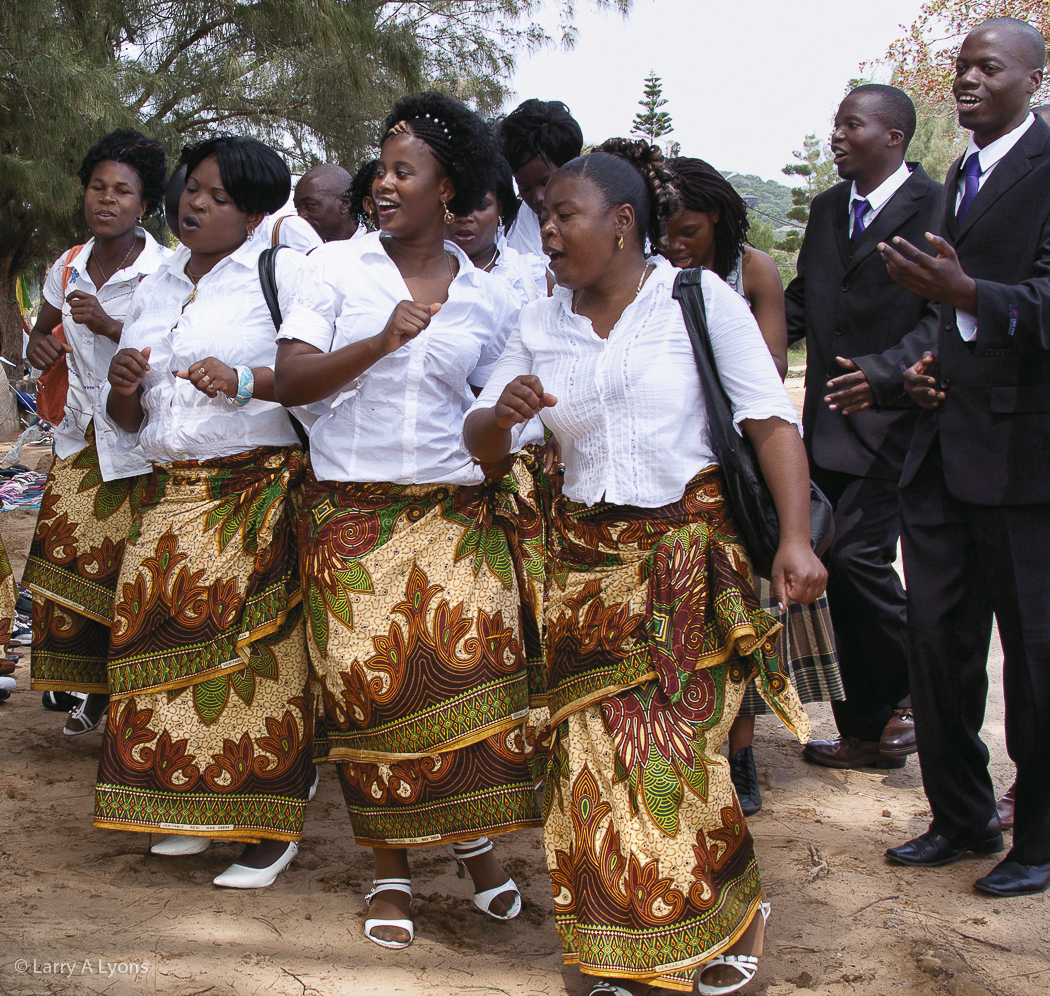
Once the wedding party arrived at the market place the celebration literally moved into “full swing”. You can feel their rhythm with their movements and the singing in their native language was absolutely beautiful.

'Party!' © Larry A Lyons

‘Party!’ © Larry A Lyons

A fisherman with his homemade raft was poling through a series of fish traps within Kosi Bay estuary. Kosi Bay is a series of four interlinked lakes in the coastal northeastern region of South Africa and is a World Heritage site.

'Gone Fishing' © Larry A Lyons

‘Gone Fishing’ © Larry A Lyons

Stay tuned. There will be upcoming posts related to more wildlife images from Africa.

Hidden Habitats! Who Knew?


To read about the images of this gallery go to:

Hidden Habitats! Who Knew?


Hidden Habitats! Who Knew?

Never underestimate what a nature park can offer and teach you. Take for example a nature park situated in New Jersey just across from the City of Philadelphia.

'View of Philadelphia' © Larry A lyons

‘View of Philadelphia’ © Larry A Lyons

The Palmyra Cove Nature Park (www.palmyracove.org) is a 350 acre site located within a highly developed urban and commercial area in southern New Jersey. The park is bordered along the Delaware River just south of the Tacony-Palmyra Bridge.

'Tacony-Palmyra Bridge' © Larry A Lyons

‘Tacony-Palmyra Bridge’ © Larry A Lyons

Five field trips to the Palmyra Cove Nature Center during the spring of 2013 provided an opportunity to observe and photograph an amazing diversity of organisms and their behavior.

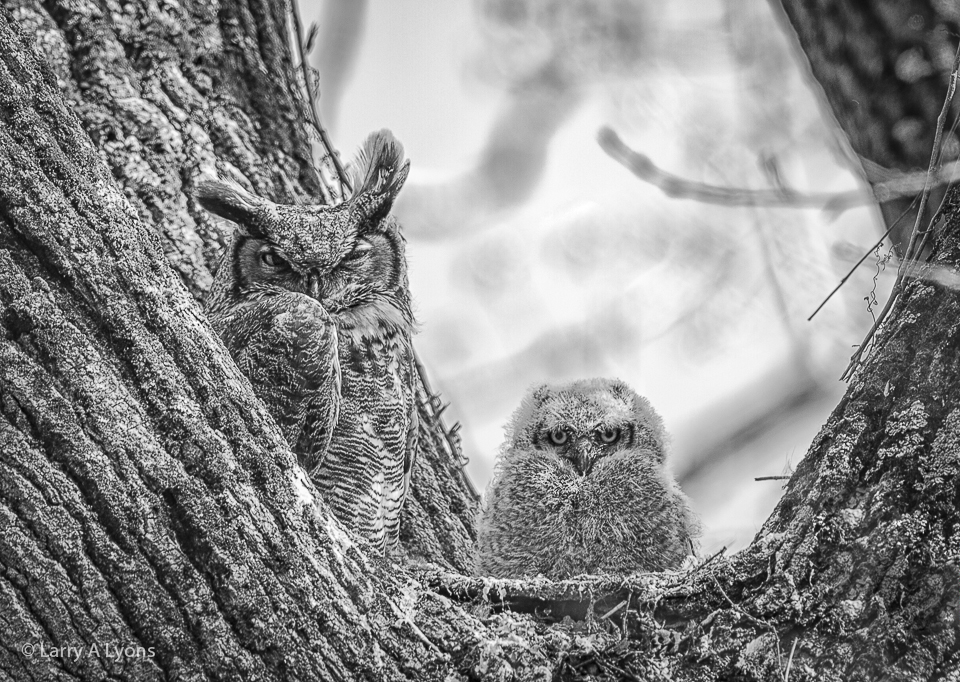
'Great Horned Owl and Fledging' © Larry A Lyons

‘Great Horned Owl and Fledging’ © Larry A Lyons

Let’s begin with the Great Horned Owl. This owl is one of the largest owls in North America and one of the most ferocious birds of prey. Both sexes tend to look similar, but the female is 10 to 20 percent larger than the male.

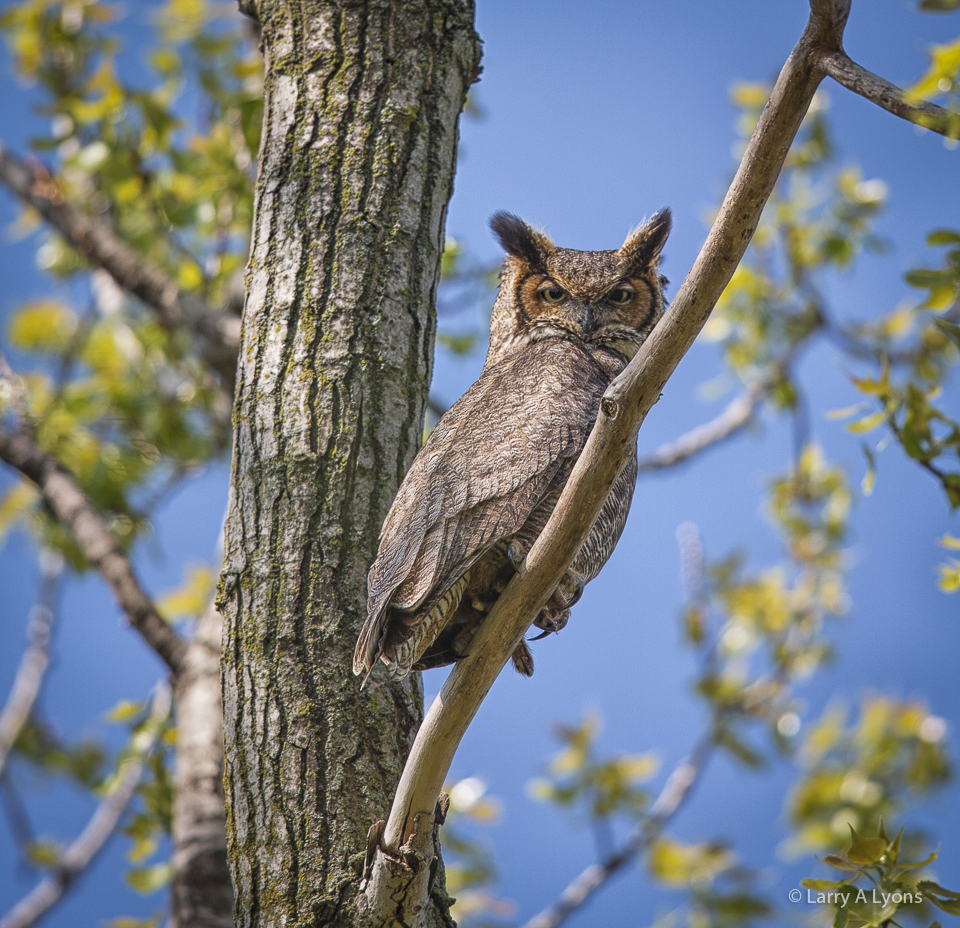
'Female Great Horned Owl' © Larry A Lyons

‘Female Great Horned Owl’ © Larry A Lyons

Distinguishing features of the great horned owl are long ear tufts, intimidating stares with their yellow eyes, and densely feathered toes with dark horned claws. General coloration does vary between the owls.

'Male Great Horned Owl' © Larry A Lyons

‘Male Great Horned Owl’ © Larry A Lyons

A pair of Great Horned Owls selected a nesting site high up in the crotch of a cottonwood tree. Nesting begins as early as January or February and the female will typically lay two eggs. After hatching the nestlings are unable to fly for ten to twelve weeks, but the owlets will venture to nearby trees.

'Owlet One' © Larry A Lyons

‘Owlet One’ © Larry A Lyons

One of the owlets remained in the original nesting site while the other owlet had moved to a lower a branch.

'Owlet Two' © Larry A Lyons

‘Owlet Two’ © Larry A Lyons

Both owlets are being cared for by both parents and remain dependent for food until the fall.

'Ferocious Predator' © Larry A Lyons

‘Ferocious Predator’ © Larry A Lyons

Great horned owls are ferocious predators and will hunt and eat all sorts of small and medium sized mammals (mice, squirrels, opossums, bats, and skunk). It will also eat small and large birds, including Canada geese, herons, ducks, and turkey. Owl prey can also be raccoon.

'Young Raccoon' © Larry A Lyons

‘Young Raccoon’ © Larry A Lyons

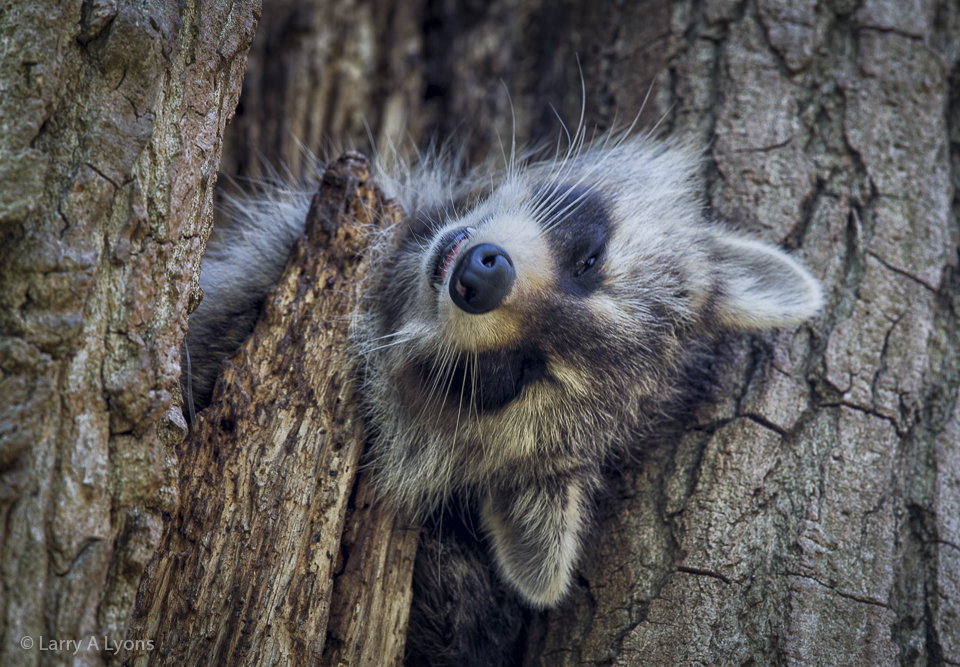
It was amazing but only 20 feet away from the tree where the owlets were being raised were raccoons residing within a tree hollow.

'Raccoon Sleeping' © Larry A Lyons

‘Raccoon Sleeping’ © Larry A Lyons

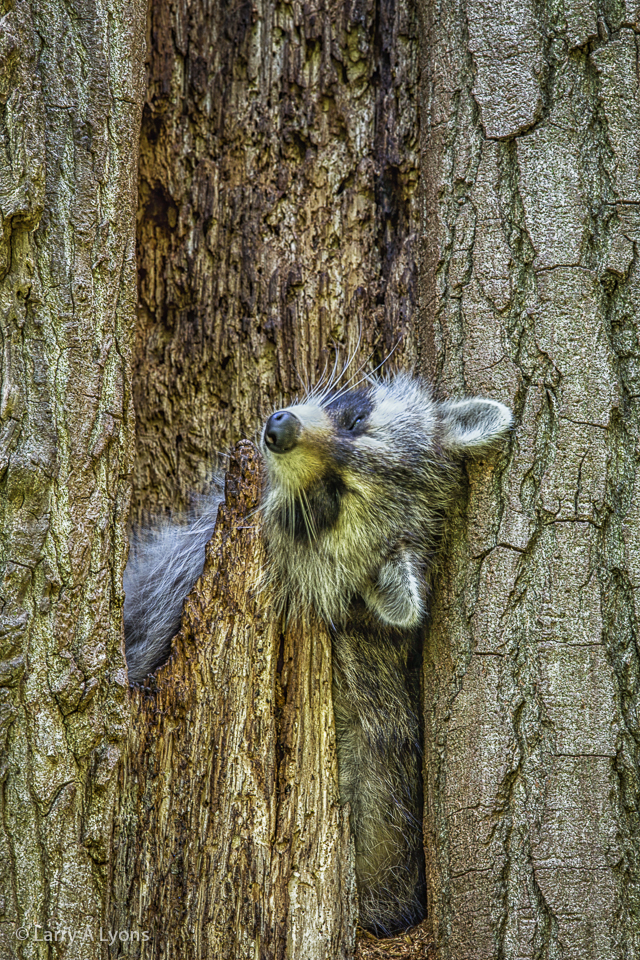
Raccoons, like great horned owls, are nocturnal and tend to sleep during the daytime. This one was resting in a vertical position in the hollow of the tree.

'Tree Hollow Home' © Larry A Lyons

‘Tree Hollow Home’ © Larry A Lyons

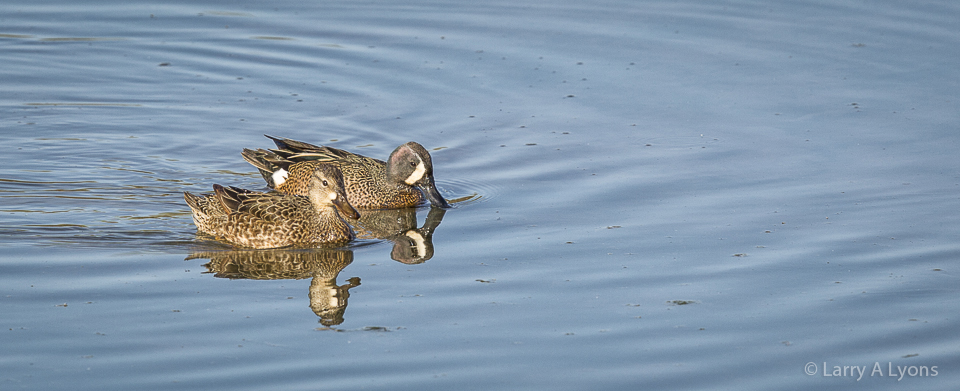
Trekking around the ponds at Palmyra Cove Nature Park can provide some great opportunities to observe birdlife and some interesting and bizarre behaviors. One such encounter involved a courting encounter amongst blue-winged teals.

Blue-winged teals are known to be the last duck to migrate north in the spring throughout most of the United States. Once they arrive in their northern breeding areas, pairs of teals will settle in vegetated wetlands and ponds to begin the next generation.

'Pair of Blue-Winged Teals' © Larry A Lyons

‘Pair of Blue-Winged Teals’ © Larry A Lyons

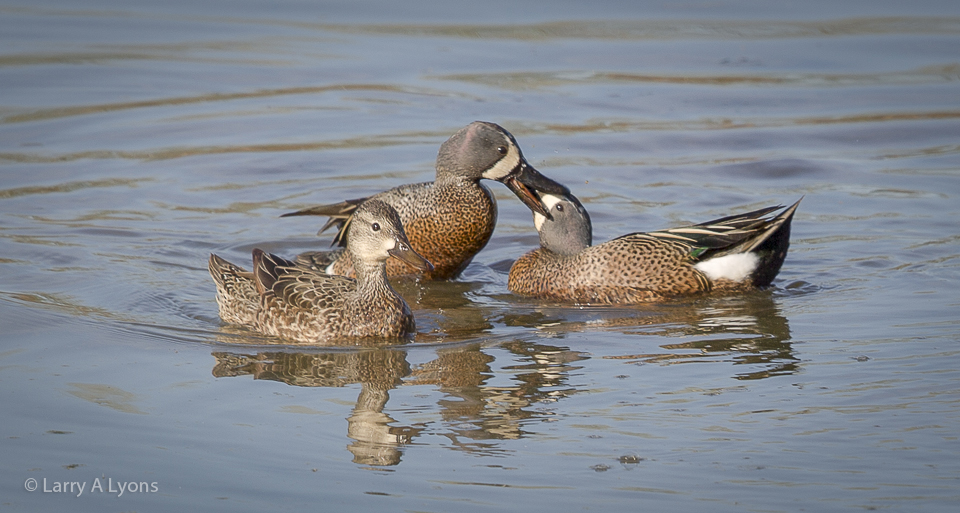
Blue-winged teals are monogamous during the mating season and are known to have some exaggerated behavior when courting. One such encounter was when another male attempted to intrude upon this pair of teals.

'One Male Too Many' © Larry A Lyons

‘One Male Too Many’ © Larry A Lyons

The paired male quickly made it quite clear by grasping the beak of the intruder.

'The Attack' © Larry A Lyons

‘The Attack’ © Larry A Lyons

The intruder was able to pull its beak away from the grasp and then was aggressively chased away.

'The Chase' © Larry A Lyons

‘The Chase’ © Larry A Lyons

Blue-winged teal are so named because both sexes have some blue feathers on their forewings, but really cannot be seen until they are taking off or in flight. The male, on the other hand, is distinguished with slate gray head and neck and white crescent in front of the eyes.

'Phew! Got Away' © Larry A Lyons

‘Phew! Got Away’ © Larry A Lyons

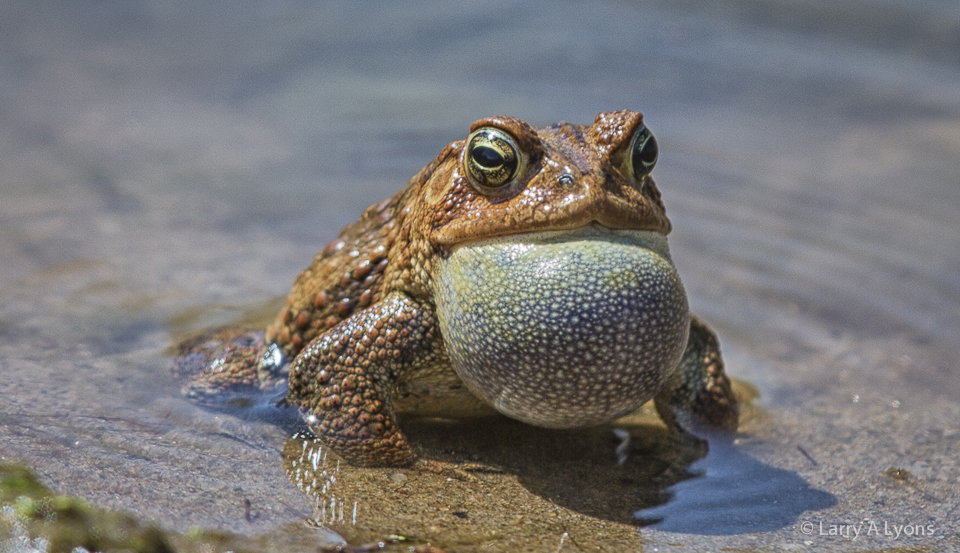
Palmyra Cove Nature Center has a frog pond that is inhabited or utilized by several different amphibians. One unusual amphibian that only visits the pond once a year to breed is the Fowler’s Toad.  The Fowler’s Toad is generally terrestrial and nocturnal except when this amphibian is in breeding mode. So, come spring to early summer, Fowlers’ Toads will venture out from the nearby woods to a wetland or shallow pond to breed. The male toad, measuring about two to three inches in size (5.1 to 7.5 cm.), will produce a call to attract the females.

'Fowler's Toad Calling' © Larry A Lyons

‘Fowler’s Toad Calling’ © Larry A Lyons

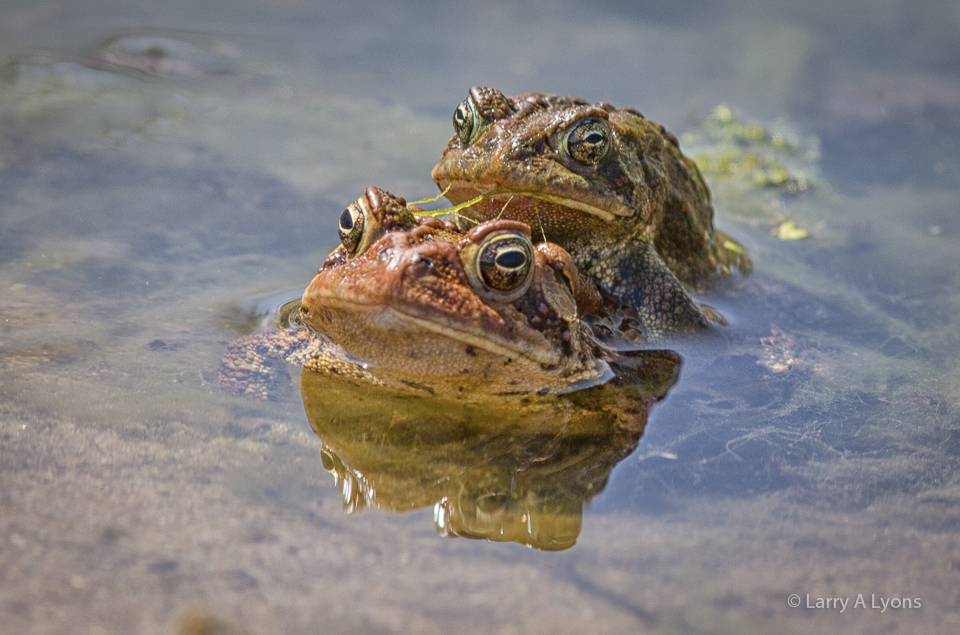
The toads will proceed into what is referred to as amplexus, also known as the “Latin Embrace”. This embrace is a form of pseudocopulation where the male grasps the female with his front legs. The male then releases a fluid with sperm into the water and externally fertilizes the female eggs. The female lays eggs in clutches up to 25,000 eggs.

'Latin Embrace' © Larry A Lyons

‘Latin Embrace’ © Larry A Lyons

There were hundreds of toads in the pond participating in this breeding ritual on this particular day. However, on a return trip of the following week, there was not a single toad to be seen, but there must had been thousands of tadpoles (about one half inch in size) swimming in the pond. Metamorphosis from tadpole to young toad occurs within two months.

The frog pond is also shared with other amphibians, such as, the green frog. This green frog surely would have found the eggs and the tadpoles of the Fowler’s Toad a tasty meal. It is all part of nature.

'Green Frog' © Larry A Lyons

‘Green Frog’ © Larry A Lyons

Canada geese are so common that their increasing populations have become a nuisance at some locations.  However, even though their presence is often taken for granted, their behaviors and their life history are quite interesting.

'Canada Goose' © Larry A Lyons

‘Canada Goose’ © Larry A Lyons

Canada geese do pair for life and will remain together over the entire year. In the spring, pairs of Canada geese will separate from their flocks and establish territories to start the next generation.

When a goose intrudes into a pairs’ territory, a lot of commotion will evolve in which the male will aggressively challenge the intruder by honking loudly, hissing with their beaks open wide and will even grab and collide between each other.

'No Intruder Allowed' © Larry A Lyons

‘No Intruder Allowed’ © Larry A Lyons

The female is responsible for building the nest and incubating the eggs while the male will be nearby guarding the nest. After the goslings hatch they will remain close to their parents.

'Canada Goose Goslings' © Larry A Lyons

‘Canada Goose Goslings’ © Larry A Lyons

Canada geese are herbivores and will feed on grasses, sedges, berries, etc. This gosling has learned quickly what is good to eat.

'Gosling Browsing' © Larry A Lyons

‘Gosling Browsing’ © Larry A Lyons

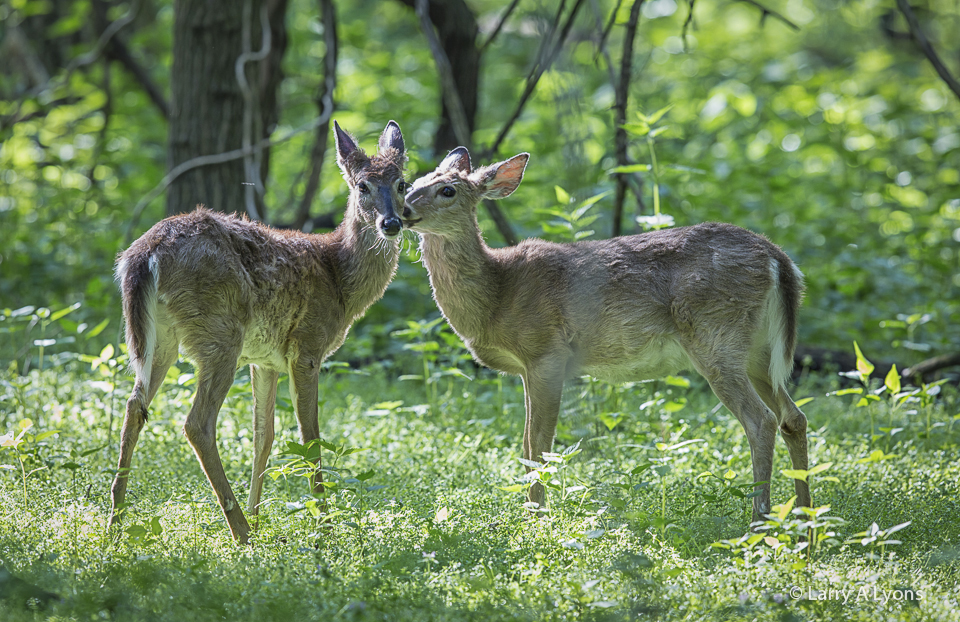
White-tailed deer is another common resident not only at the Palmyra Cove Nature Center, but also throughout the woodlands and suburbs particularly within northeastern United States. The deer are usually best seen in the early morning or at dusk when they are browsing along the edges of woodlands.

'Young White-Tailed Deer' © Larry A Lyons

‘Young White-Tailed Deer’ © Larry A Lyons

Their winter or early spring coats are brownish grey but they will turn to reddish-brown in the summer. The female deer (doe) stands at about 3 feet at shoulder height and will weigh up to 100 pounds.

'White-Tailed Deer' © Larry A Lyons

‘White-Tailed Deer’ © Larry A Lyons

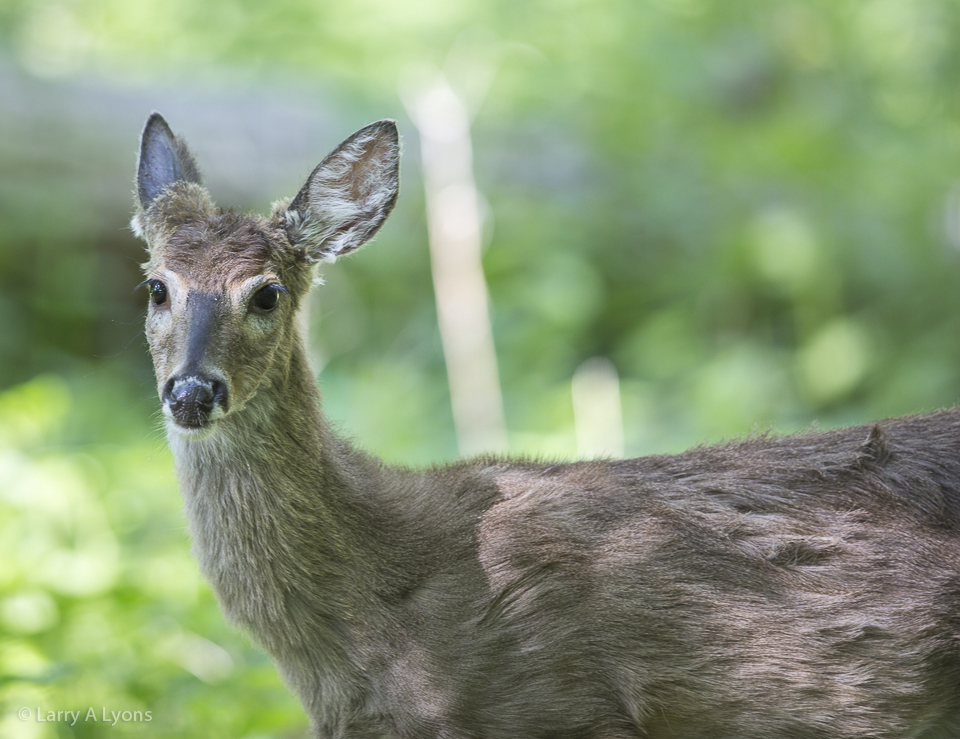
White-tailed deer are herbivores and will forage on a wide diversity of plants, including agricultural crops, at a rate of 2 to 7 lbs. per 100 lbs of body weight each day.

'Doe Close-up' © Larry A Lyons

‘Doe Close-up’ © Larry A Lyons

White-tailed deer populations do present significant concerns that have caused negative effects to the deforestation of woodlands. Deer-related collisions with vehicles have also been an increasing problem with the overpopulation of deer.  Attempting to maintain or manage deer populations at densities that will not be detrimental has become more and more challenging.

'Drake Mallard' © Larry A Lyons

‘Drake Mallard’ © Larry A Lyons

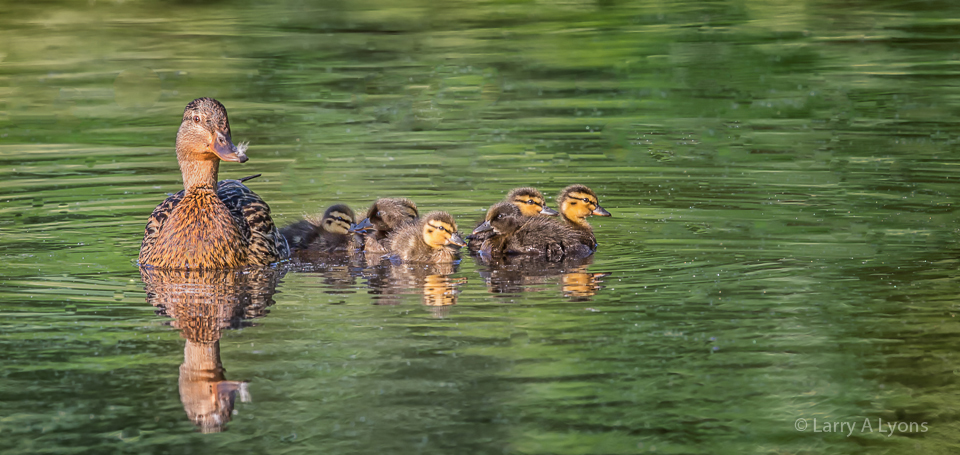
No nature park is without mallards, the most common duck in the United States. The female mallard lays an average of nine eggs and is responsible for incubating the eggs and taking care of the ducklings.

'Female Mallard and Ducklings' © Larry A Lyons

‘Female Mallard and Ducklings’ © Larry A Lyons

To reiterate the take home message of this post: Don’t underestimate what a nature park can offer and teach you. Here was a nature park situated in a highly dense urban area that provided an incredible assortment of habitats. The combination of these habitats allowed for the propagation and sustainability of a diversity of wildlife from amphibians to owls, ducks, songbirds and geese to deer and raccoons.

Let’s get our children outdoors and away from their electronic devices.  Let them find hidden habitats and enjoy the many wonders of nature. It is “our” next generation that will be responsible for continuing efforts to protect wildlife and maintain a commitment for preserving habitats.

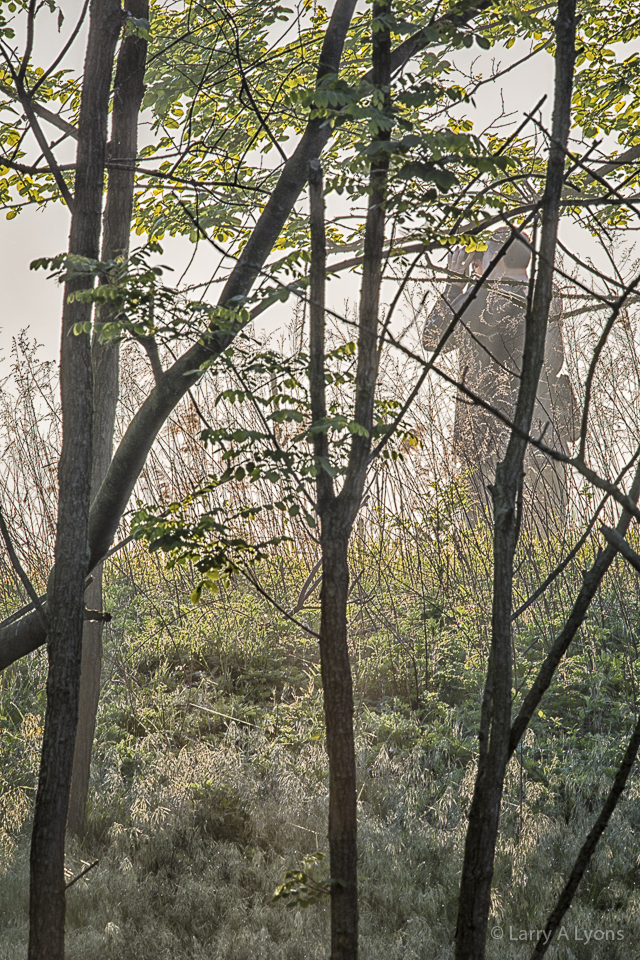
Observe, enjoy, learn and, if you are so inclined, photograph them.

"A Birder' © Larry A Lyons

“A Birder’ © Larry A Lyons

References:

http://www.palmyracove.org

http://animaldiversity.ummz.umich.edu/

http://srelherp.uga.edu/anurans/buffow.htm

http://njaes.rutgers.edu/pubs/fs1202/white-tailed-deer.asp

http://www.allaboutbirds.org/


The Osprey Comeback

Osprey populations were decimated from the 1950’s to the 1970’s resulting primarily from the widespread use of a persistent insecticide, known as DDT. There were regions in the United States where 90 percent or more of the breeding pairs disappeared. Over 500 osprey nests were present in New Jersey prior to the effects of DDT. By 1974 only 50 nests remained in New Jersey.

'Osprey Comeback' © Larry A Lyons

‘Osprey Comeback’ © Larry A Lyons

The osprey has become the symbol of how nature can recover from environmental atrocities. DDT was banned in New Jersey in 1968 and banned almost entirely in the United States by 1972. Recovery of the osprey populations began once these bans were implemented.

'The Food Chain' © Larry A Lyons

‘The Food Chain’ © Larry A Lyons

The mechanism of toxicity resulting from DDT to predatory birds, like the osprey, is quite complex that ultimately affects their reproductive success. DDT is a persistent organic pollutant that tends to concentrate as it moves through the food chain. Fish that could be contaminated with DDT from eating shrimp or crabs would further magnify the concentration of DDT in predatory birds, like the osprey. The accumulation of DDT and its metabolites in the osprey prevents calcium metabolism causing the thinning of the eggshells. As a result of the eggshell thinning, the osprey would crush the eggs when sitting on them during incubation.

'Protect The Osprey' © Larry A Lyons

‘Protect The Osprey’ © Larry A Lyons

The 1962 landmark book “Silent Spring” authored by Rachel Carson clearly expressed how important it is to maintain a vigilance on the use of chemicals and their fate in the environment. This book is often attributed to the environmental movement that was initiated in the 1960’s.

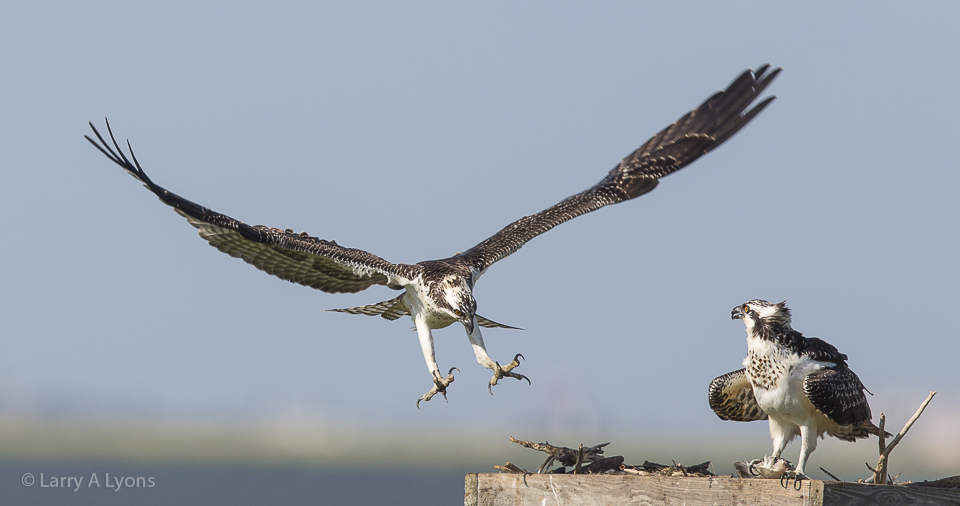
'Birds of Prey Socializing' © Larry A Lyons

‘Birds of Prey Socializing’ © Larry A Lyons

All of the osprey images were photographed at the Edwin B. Forsythe National Wildlife Refuge located on the southern coastline of New Jersey. This refuge, situated just north of Atlantic City, NJ, encompasses 47,000 acres of coastal habitat and is an important sanctuary for a wide diversity of birds and other wildlife. A future post will present many other birds that utilize this refuge.

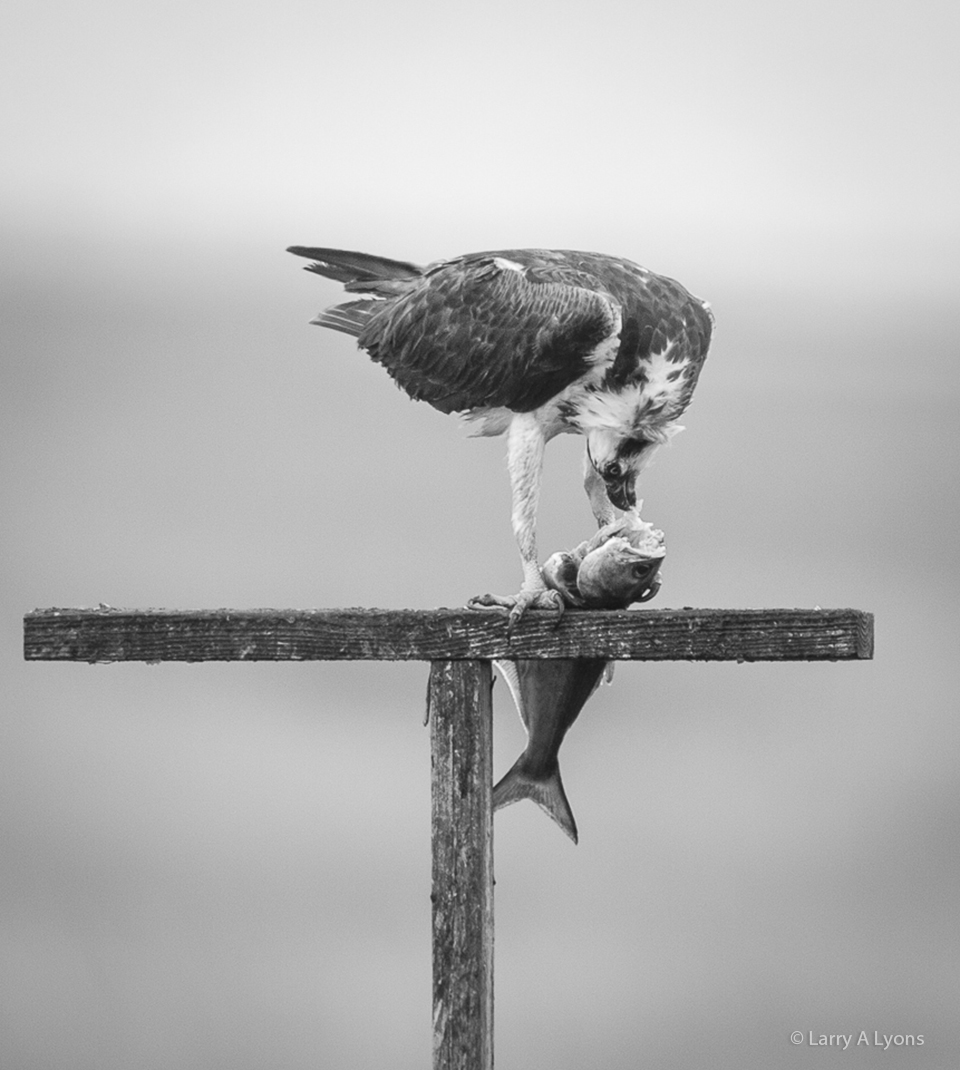
The osprey, also referred to as the fish hawk, has a diet that is almost entirely made-up of fish.

'The Fish Hawk' © Larry A Lyons

‘The Fish Hawk’ © Larry A Lyons

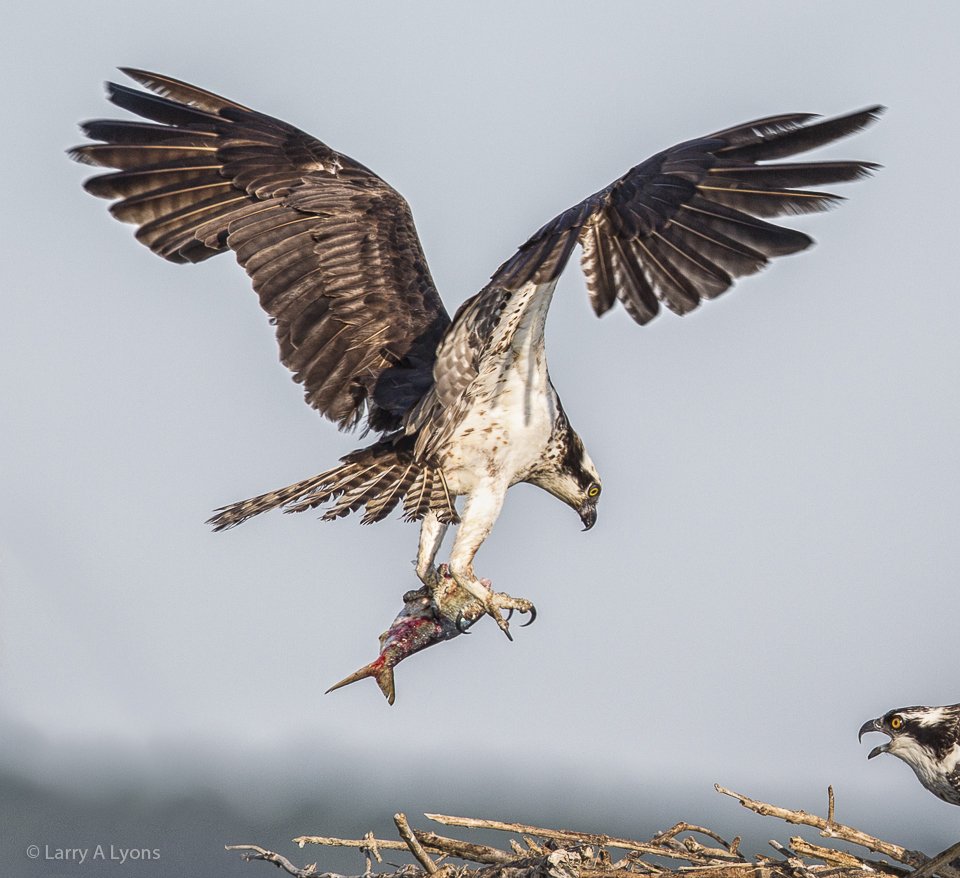
Ospreys have gripping pad on their feet that aids in plucking the slippery fish from the water with their long curved talons. The osprey will orient the fish head first to reduce wind direction when carrying the fish in flight. Here a flounder is being carried back to the nest.

'Entree of Flounder' © Larry A Lyons

‘Entree of Flounder’ © Larry A Lyons

The osprey stands between 21 to 23 inches (53 to 58 cm.) and has a wingspan of up to six feet (1.8 meters).

'Six Foot Wingspan' © Larry A Lyons

‘Six Foot Wingspan’ © Larry A Lyons

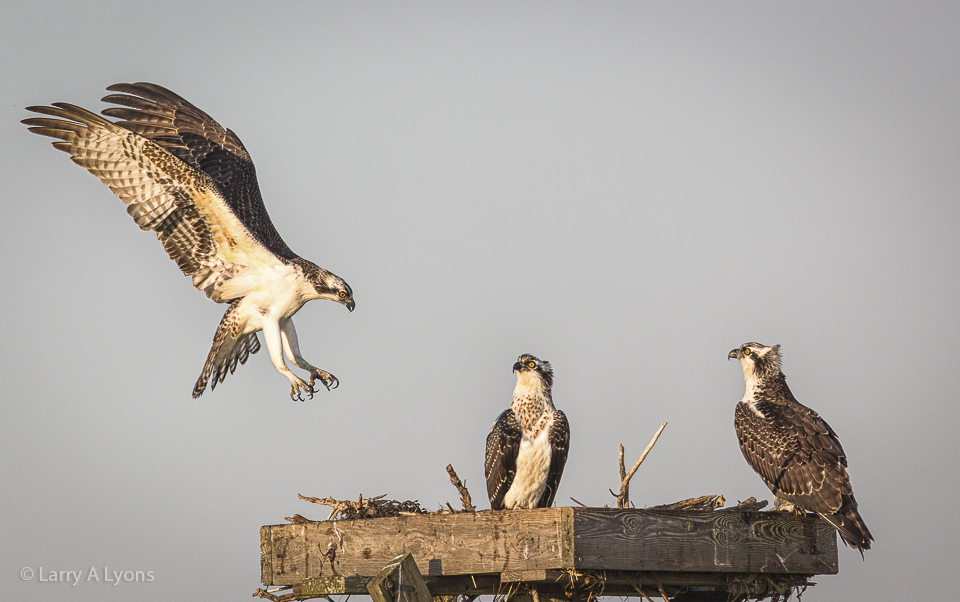
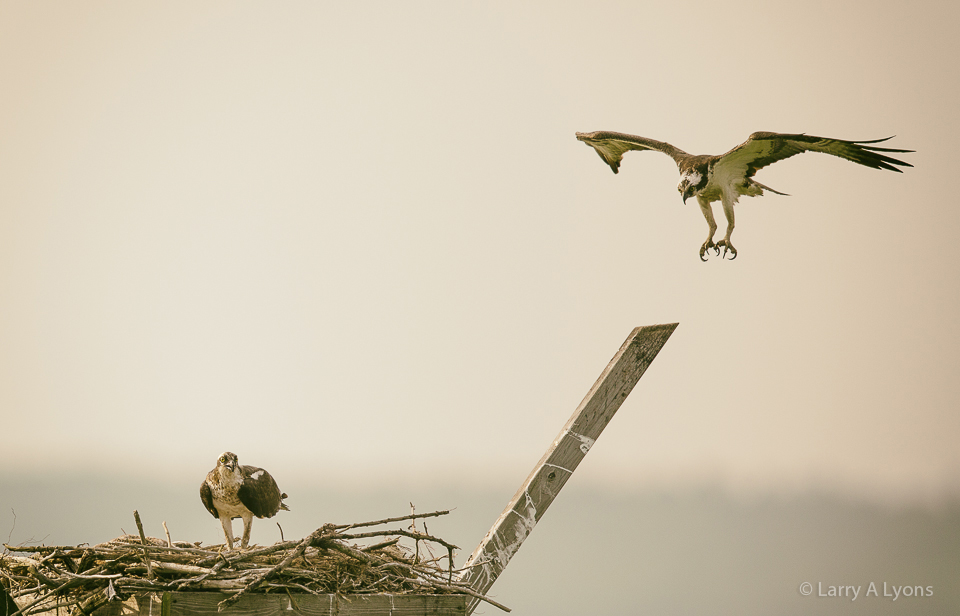
They do require suitable tall structures for building their nests. Platforms are often constructed to allow a suitable structure for nest building.

'Osprey Platform' © Larry a Lyons

‘Osprey Platform’ © Larry a Lyons

Osprey nests are built of sticks and lined with grasses or seaweed. The male usually fetches most of the nesting material and the female arranges it. At the Forsythe refuge there are at least eight to ten platforms for the ospreys to build their nests.

'Nest Building' © Larry A Lyons

‘Nest Building’ © Larry A Lyons

Males and females do appear similar in appearance, but there are some slight differences that can distinguish between the sexes. Males have a slimmer body and narrower wings. Also, the coloration of the breast band is either lighter or not present in the males.

'Osprey Pair' © Larry A Lyons

‘Osprey Pair’ © Larry A Lyons

Ospreys mate for life and return to the same nest year after year. They migrate back north in the Spring usually around the beginning of March.

'Feeding The Chicks' © Larry A Lyons

‘Feeding The Chicks’ © Larry A Lyons

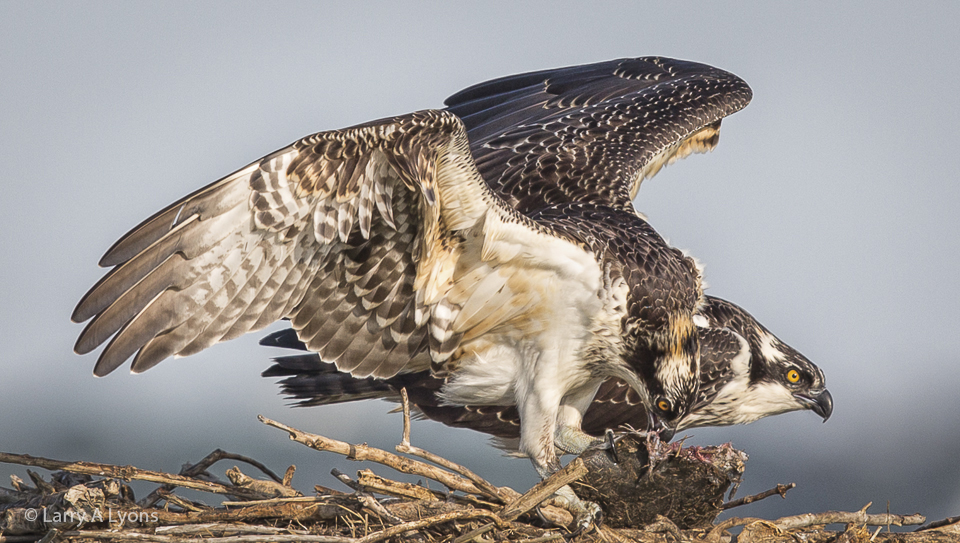
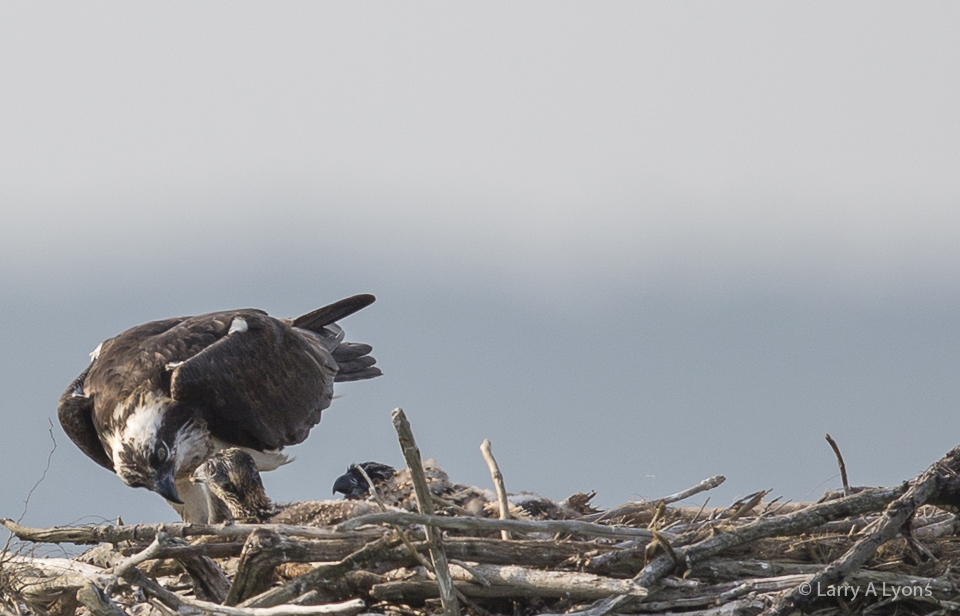
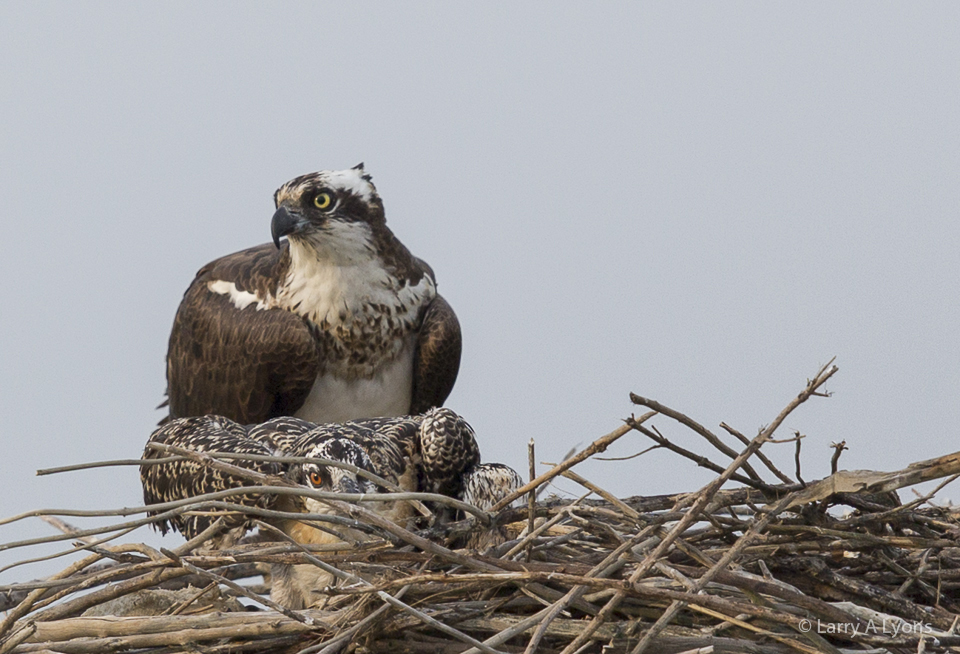
The female typically lays three eggs and both parents help to incubate the eggs. Osprey eggs do not hatch all at once, but rather hatching is staggered in time so some siblings are older and more dominant. The pair works together to raise the young.

'Peek A Boo' © Larry A Lyons

‘Peek A Boo’ © Larry A Lyons

The young fledge at about eight weeks of age and then remain in the area of the nest for about two months.

'On Watch'  © Larry A Lyons

‘On Watch’ © Larry A Lyons

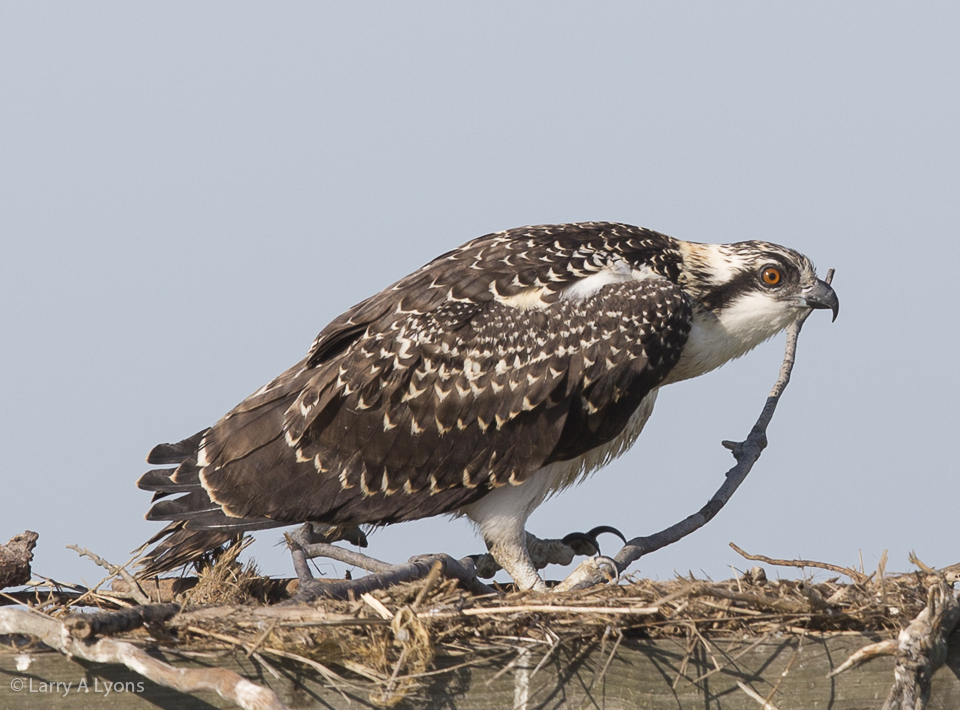
Juvenile ospreys have buff fringes to the plumage of the upper parts, a buff tone to the underbody, and streaked feathers on its head. Juveniles also have orange pupils that turn yellow when they reach adulthood.

'Juvenile Osprey' © Larry A Lyons

‘Juvenile Osprey’ © Larry A Lyons

The adults and the juvenile ospreys will begin their southern migration by the end of August or beginning of September to their wintering grounds in Florida, the Caribbean, Central America and South America.

'Are You Ready To Head South?'© Larry A Lyons

‘Are You Ready To Head South?’© Larry A Lyons

Ospreys are a conservation success story. Both the pesticide bans and the construction of artificial nest sites continue to allow for the comeback and growth of osprey populations.

'Enjoy, Don't Endanger' © Larry A Lyons

‘Enjoy, Don’t Endanger’ © Larry A Lyons

Leave you with a quote by Rachel Carson: “The more clearly we can focus our attention on the wonders and realities of the universe about us, the less taste we shall have for destruction.”

References:

http://www.fws.gov/refuge/edwin_b_forsythe/

http://www.conservewildlefenj.org/

http://en.wikipedia.org/wiki/osprey

http://www.allaboutbirds.org/guide/osprey/id

http://animals.nationalgeographic.com/animals/birds/osprey/

http://www.fws.gov/chesapeakebay/osprey.html

The Osprey Comeback

To read about the images of this gallery go to:

The Osprey Comeback

The Cheetah


To read about the images of this gallery go to:

The Cheetah